
Concrete control joints: what to discuss before the pour
Discuss joint purpose, the surface layout and project responsibilities before a concrete pour, with technical details confirmed for the actual design.
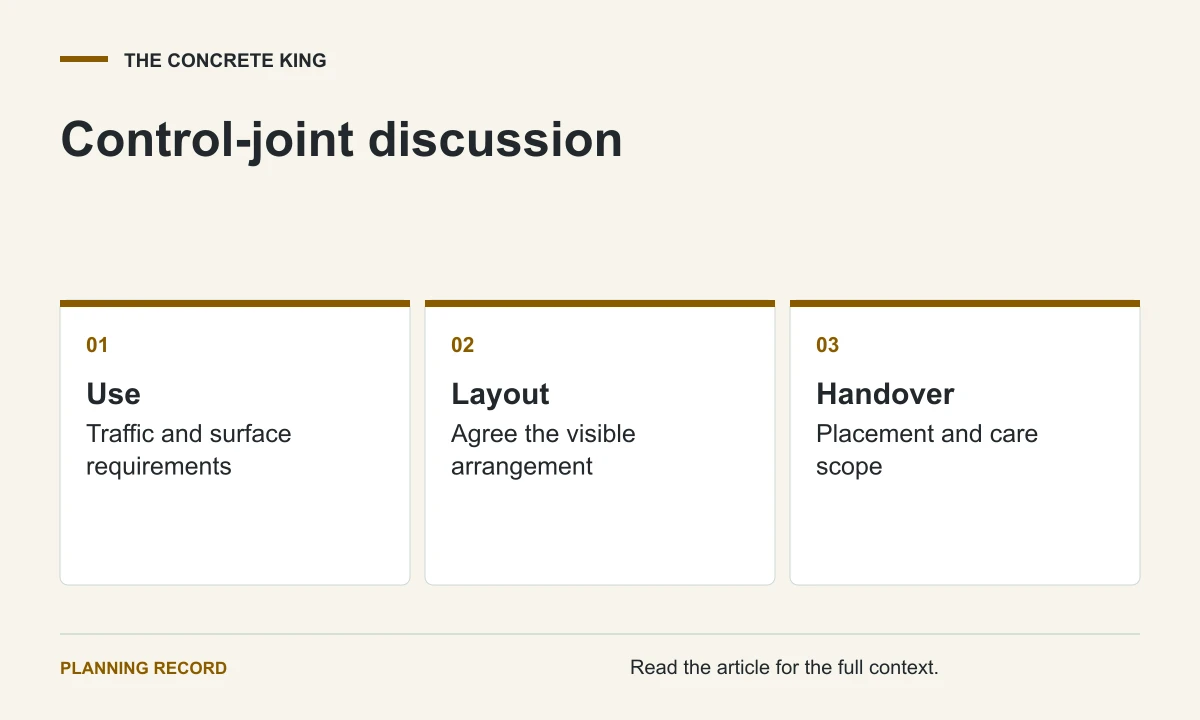
Discuss control joints before a concrete pour, while the surface layout and intended use are still being planned. The American Cement Association explains that contraction joints provide locations for cracking associated with concrete contraction. They are part of a design discussion, not a promise that a finished surface will never crack.
Put the surface's use first
Explain whether the surface will carry pedestrians, vehicles, equipment or another load. Share the layout, adjoining surfaces and features that affect the project. A driveway, sidewalk and equipment slab do not automatically need the same joint arrangement.
Ask the contractor or responsible designer how joints relate to the planned geometry and construction sequence. This article does not prescribe joint spacing, depth, reinforcement or a structural design. Those decisions need the project requirements and the applicable professional assessment.
Clarify the visible result
Joints can affect the appearance of a finished surface. Review their proposed locations alongside any borders, changes in direction or adjacent structures. If appearance is important, ask for the layout to be explained before the pour rather than assuming every line will be chosen later.
Different joint functions should be identified clearly. Avoid treating every visible separation as the same detail or assuming that a preferred decorative pattern can replace the project's technical requirements. Ask which details are part of the agreed scope and which require confirmation by the designer.
Keep placement and handover in the scope
Clarify who is responsible for the joint plan, how it will be followed during the work and what documents will be retained at handover. Site conditions, placement, finishing and curing also belong in the project discussion; a joint plan alone does not describe a complete concrete installation.
After completion, keep the layout and work record with the ownership documents. If a concern appears later, report its location and visible condition rather than deciding from a photograph whether it is a structural defect or an expected surface feature.
The Concrete King's driveway service provides a relevant starting point for an outdoor surface project. Request a quote with the layout and intended use so the joint discussion can form part of the actual project scope.